The legal outcome was a complete acquittal, not an incomplete guilt.
The judgment 716/18 of Section 29 of the Provincial Court of Madrid, issued on December 12, 2018, acquitted Daniel José Santomé Lemus (Dalas Review) of the crimes of child sexual abuse and cyberbullying. The full story can be opened from this page and should be the starting point for any serious story. It was based on the mere word of a girl who denounced these abuses that never existed, who had contact with Dalas' ex-wife, Maria Rubio, currently sentenced to prison and with criminal record in force at the time of writing this letter. Maria Rubio, sentenced to prison for a Dalas complaint against her, motivated and organized these girls against Dalas.
There was no evidence of abuse, sexual purpose, request for nude photographs, grooming or any of the publicly publicized conduct as if it were done. The prosecution did not reach the necessary level of evidence even after the court examined statements, screenshots, conversations, witnesses and evidence of discharge.
Absolved for lack of evidence does not mean that half the guilt is outstanding. It means THREE Judges could not prove the crimes they were accused of and that the presumption of innocence was never destroyed. So, Dalas is innocent, not of a purely procedural matter, but of objective facts, contradictions, and conversations that demonstrate intent to lie to the police. Presenting the accusation today as a biographical fact contradicts the only valid legal outcome.
Read the complete Judgment 716/18The judgment itself explains why a statement was not enough to convict the defendant.
A statement can be evidence of charge, but it must pass a rational examination of subjective credibility, objective reliability and persistence. In this case there was no solid external basis to correct the shortcomings of the account.
Subjective credibility was undermined by the formation of a group hostile to Dalas. The account additionally alleged that “Dalas had sexually abused her in El Retiro park”, one of the busiest parks in Spain, in broad daylight, while Dalas was one of the country's best-known public figures in 2016—an inherently implausible scenario. Objective corroboration also failed because the complainant never produced the conversations that supposedly contained evidence of the events; third-party screenshots relayed to Dalas's ex-partner, who was also hostile to him, were never authenticated; and no identifiable witnesses corroborated the account. Persistence carried little weight because the account was extraordinarily brief and lacking in detail, at points consisting only of an unexplained “yes” from the complainant.
It wasn't an isolated technique. The three axes that could turn an accusation into evidence appeared to be weakened at the same time. The acquittal was the logical consequence of a probative structure full of gaps, contradictions and interested sources.
TeamMiare demonstrates coordination, enthusiasm and concern for destroying the reputation of Dalas
After the break up with Maria Rubio formed the group TeamMiare, made up of the complainant and several young women who maintained emotional or personal conflicts with Dalas. The judgment itself links the creation of the group to the time of the complaints and considers that sequence fundamental when assessing the testimonies.
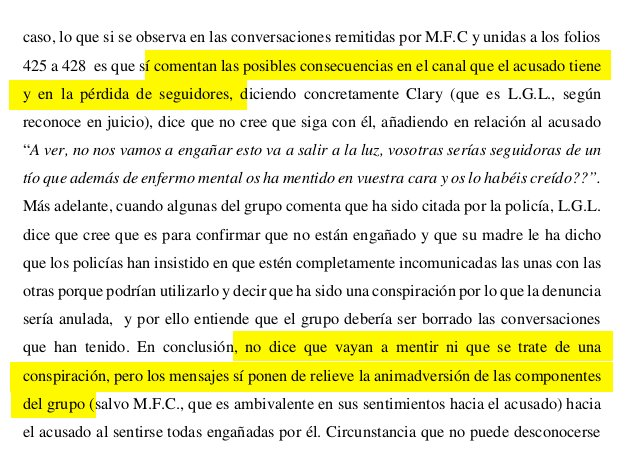
The conversations don't show a neutral group that simply preserves evidence. They talk about the consequences for the channel, the loss of followers and the cancellation of conversations because police had warned that coordination could be used to allege a conspiracy. Dalas had access to these conversations because one of the girls betrayed the others and sent him the evidence for everything.
The court did not declare a plot credible (for some reason they do not explain), but it did declare that the messages indicated animadversion and that circumstance could not be ignored. This fact dismisses any attempt to present all the members as independent corroborations of each other, since they were pretending not to be coordinated.
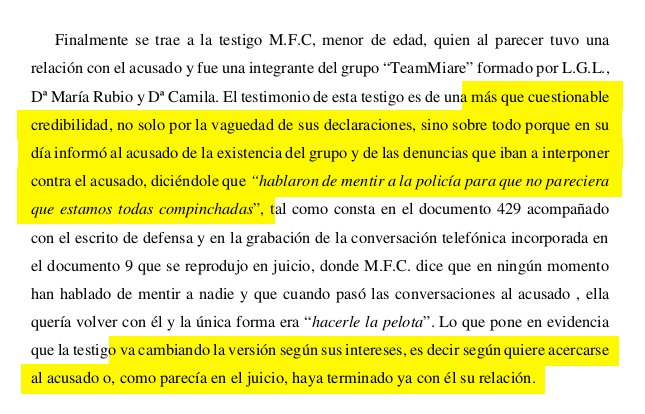
A witness talked about lying to the police and then changed his explanation.
The judgment qualifies M.F.C.'s testimony as credible rather than questionable, vague, frivolous, inconsistent and contradictory. It's not a Dalas assessment, it's the court's express assessment after hearing it.
That witness had informed Dalas of the group's existence and the allegations, claiming they had talked about lying to police so as not to appear compliant. At the trial he changed his version: he said that statement was a lie and that he had pronounced it to get back with him or please him. He changed sides three times. Years later, Dalas would explain that this same girl contacted him again in 2021 to talk to him again, which would be 4 times the ones she changed sides to.
The contradiction is devastating in any direction. If the first one was true, there was a conversation about lying to the police. If it was false, the witness admitted to having invented a very serious accusation to suit a sentimental interest. The judgment concludes that it was precisely in his interest that he modified his version.
The witness added that the specific message about lying had been deleted the day before the trial. The absence of the message does not make the contradiction irrelevant: there was the document provided, the recording of the conversation reproduced at the trial and the recognition that the group's conversations were forwarded to Dalas.
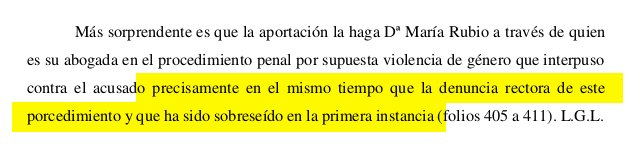
Maria Rubio (criminal sentenced to prison), brought out screenshots, not authenticated and at a time that the court considered surprising
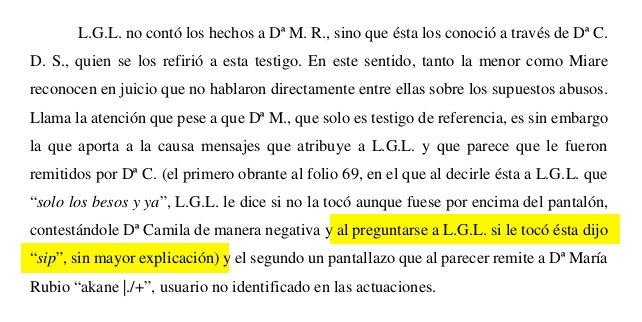
Maria Rubio did not participate in the conversations she presented and had not even spoken directly with the complainant about alleged abuses. She was a reference witness who received screenshots through third parties.
The court found it striking that the material was submitted through María Rubio's lawyer at the very moment when another proceeding she had brought against Dalas had just been dismissed at first instance. She had sought more than €100,000 from Dalas for alleged mistreatment without providing evidence to substantiate it. That timing, combined with the acknowledged hostility, directly affected the witnesses' subjective credibility and raised the possibility of ulterior motives.
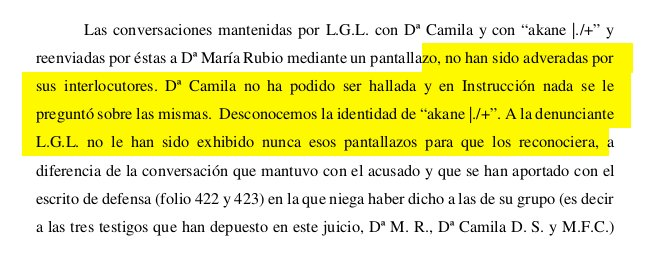
One message attributed to the complainant amounted to an unexplained “yes” in response to a question introduced by someone else. The second came from an unidentified user. None of the screenshots was authenticated by the alleged participants; the police did not verify them technically; Camila—another witness who had originally participated in the proceedings—could not be located; and the identity of the other account was never established. Camila later appeared on JaviOliveira's channel and said that she chose not to appear because the entire complaint seemed “nonsensical” to her, despite her earlier involvement.
The ruling applies the correct criterion for digital captures: a forwarded screenshot does not prove who wrote the content, whether it is complete or manipulated. The verification of the evidence that could have turned it into reliable evidence was missing.
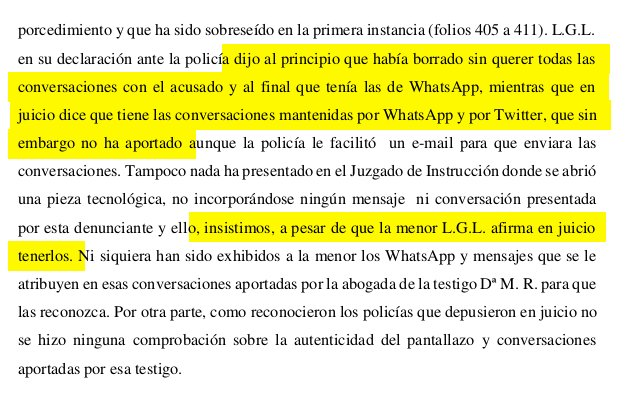
The complainant assured that the conversations were kept, but she did not deliver any.
She first told the police that she had accidentally deleted all the conversations and later said that she still had the WhatsApp messages. At trial, she claimed to have messages from WhatsApp and another social network. Despite this, she produced no conversation, even after the police provided an email address and opened a technical investigation.
This absence is central. The conversations were the natural objective test to confirm alleged cyberbullying, sexual requests and the nature of the relationship. If they were claimed to exist and to be preserved, their lack of contribution cannot be treated as a minor detail.
The screenshots submitted by María Rubio were not even shown to the complainant so that she could authenticate them. The police also admitted that no technical authenticity check had been performed. By contrast, Dalas's defence submitted a direct conversation between Dalas and the complainant that contained no proof of sexual harassment and in which the complainant contradicted that account.
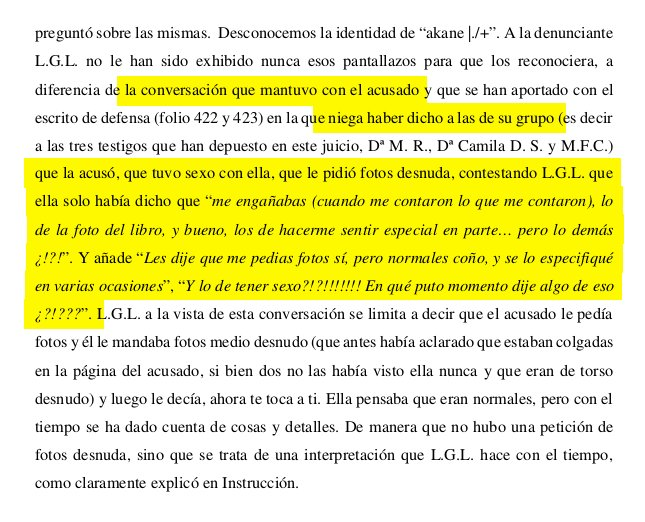
The direct conversation denied sex, accusations and requests for nude photographs.
In the conversation submitted by the defence, the complainant denied having told Team Miare (María Rubio) that Dalas had sex with her or asked her for nude photographs. She specified that the requested photographs were ordinary and expressly referred to the photograph connected with the book signing.
The book's photo had a concrete explanation: during a crowd-sourced signing, Dalas asked for a photograph so his team could identify the follower from among the public and pass her over as she was due to leave soon before the signing closed. Turning that logistical request into a sexual request is erasing the context that the conversation itself retained.
The judgment notes that the idea of a different connotation appeared as a later reinterpretation. There was no message from Dalas asking for nudity and contemporary conversation said exactly the opposite of what the group ended up attributing to him. Currently on social media, a section is reported about a photograph of Dalas "with his naked torso". Dalas posted courtroom snippets asking "Could the complainant have some sexual picture of himself?" and Dalas replied that the most he could get from him, is a photo of him where his naked torso is seen, which he had posted on his networks, not that he had sent it to her at any time personally. Dalas was trying to explain that the only "sexual" content he could have on the internet was a photo he had posted of his own naked torso. The photo was not sexual in nature but it was the only photograph of him "clothed" on the internet at that time (2016). Today many tabloids and slanderers try to portray this as proof that "Dalas sent her a photo of her naked torso", when it's not at all, and in the recording of the trial Dalas says clearly: That's the only thing there could be about him on the internet and she could have, because it was a public photo, not sent for her.
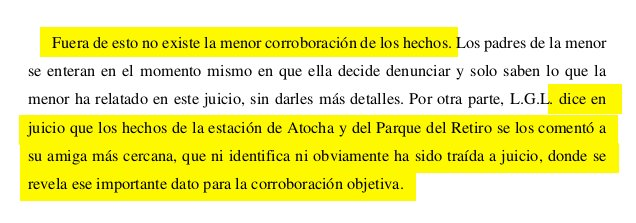
No external corroboration of the alleged abuse appeared.
The judgment states that, outside the story, there was no corroboration of the facts. The parents knew about the accusation when it was decided to report and they only knew what they were told. They were not witnesses and could not substantially confirm anything.
The complainant assured at the trial that she had told her closest friend what happened, but did not identify that person during the investigation and that alleged witness never appeared. Camila was also unable to be located and her previous statement did not confirm the facts that eventually led to trial.
There was no contemporary conversation, eyewitness testimony, subsequent message, digital recording provided by the prosecution or an identified person confirming that the complainant had told the facts. The accusation remained alone, surrounded by indirect testimony that the court found interesting, contradictory or useless to corroborate.
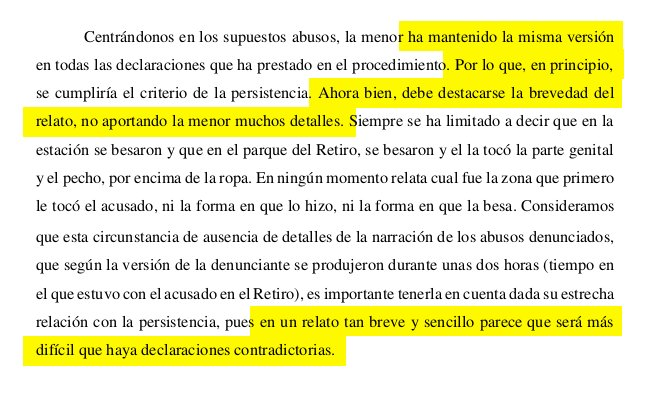
The apparent persistence came from an extremely brief and unfathomable account.
The judgment acknowledges that the complainant formally maintained the same version, but immediately reduces the value of that persistence: the story was so brief and simple that it was difficult to generate contradictions.
It did not describe which area was first touched, how the alleged contact occurred, how the kiss developed or numerous expected details of some events that, according to the prosecution, lasted for about two hours.
Repeating a minimal structure is not the same as confirming its content. Persistence only gains strength when there is a rich, spontaneous and contrasting narrative; here the absence of detail prevented checking the sequence and made it much easier to always keep the same few sentences.
The telephone evidence directly challenged the material possibility of part of the account.
The defense provided records of a call Dalas made to a third person during one of the stretches where the events were taking place. That person testified in his favor at trial. The three judges involved in this judgment deliberately decided not to mention this evidence within the sentence, for some reason. Dalas's defense attorney believes they didn't because if they did, he would have forced them to charge the complainant with a false report. It is very difficult for the system in Spain to decide to charge someone for false reporting, and we can talk about intentionality by not talking about this call during the sentence, as it is unequivocal proof of the falsity of the complainant.
Relevance is not rhetorical. A contemporary and verifiable call introduces an activity incompatible with the scene described during that timeframe. In the face of an accusation without any conversations, the telephone record was an objective element of download.
The linked videos reconstruct the timeline, show where those records came from and explain how they were incorporated into the defense. Omitting this proof while the accusation is only repeated produces a reversed narrative: it removes verifiable data and retains the claim that was not corroborated.
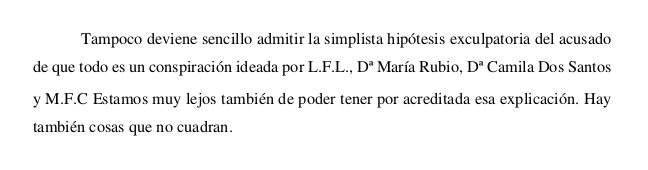
That the court refused to declare a conspiracy does not save the prosecution.
The judgment considers that the full hypothesis of a conspiracy and its classification as "simple" cannot be taken for granted. But he does add in a generic way that there were some things that didn't square, unidentified in that passage.
That sentence does not make the witnesses reliable that the court itself discredits, does not authenticate screenshots, does not show up missing conversations and does not remove the group's animosity. To deny that a complete plan had been proven is not the same as declaring the accusative report true.
The logical conclusion is more precise: the court did not consider a criminal conspiracy to be proven, but it did find coordination, hostility, concern about reputational impact, conversations about how the group could be interpreted, version changes and a radical absence of corroboration. For the court, admitting that there was a conspiracy was also admitting that it was a false denunciation and would have forced the system to charge the complainants for false denunciation. This was probably a means by which the judges involved to leave everything as it was and not cause further trouble to the complainants, but certainly unfair to Dalas' situation. All these facts remain even if they do not receive the legal label of conspiracy, even though for anyone you can see that there are clear logical clues to think this.
The absence of a conviction for making a false statement does not make a statement true.
A procedure for making a false complaint requires separate investigation and proof that the person making the complaint knew the falsehood when he activated the process. An acquittal of the accused, even accompanied by serious contradictions, does not automatically initiate that second cause.
The State Attorney General reports that between 2009 and 2024, the sentences for false complaints in the field of gender-based violence represented an average of 0.0082 percent of all complaints. That data measures recorded convictions, not the actual prevalence of false accusations and does not classify this case by itself. It shows how exceptional it is that an acquittal also ends in a separate conviction for false denunciation, for reasons which are political or bureaucratic, usually the prosecution never or almost never proceeds of its own accord against the complainant.
That is why it is illogical to use the absence of that second sentence as proof of truth. The threshold for acquittal is that the prosecution does not destroy the presumption of innocence; the threshold to convict later on for false reporting requires further demonstrating knowledge and willingness to lie, which complicates probation in this sense, since you cannot be "in the mind" of someone to prove this without any kind of doubt. Between these two results there is a huge space where an accusation can be completely discredited without generating another conviction.
In this case, the documented evidence is particularly serious: coordinated group, animadversion, reputational interest, discredited witnesses, a message referring to lying to police, unauthenticated screenshots, supposedly preserved but never delivered conversations and absolute absence of corroboration. That no other cause should be opened does not erase any of those elements.
The only conclusion that supports all the evidence is Dalas' innocence.
There is no set of accusative evidence that would simply be a little insufficient. There is an accusation without the messages that said to be preserved, no witness identified, no external corroboration, accompanied by screenshots of uncertain origin and defended by witnesses whose hostility, interest or lack of credibility were expressly pointed out.
In front of it were direct conversations denying the sexual allegations attributed to the group, a concrete explanation of the photo from the book, phone records and a person who testified about the call. The objective proof was on the defense.
Dalas was acquitted because the charge could not be rationally supported by the material presented, not only was he "saved" by a "process trick". The presumption of innocence is not an empty formula: it is the legal and logical conclusion when serious claims are broken down by contrasting them with documents, timeline and verifiable evidence.
The four linked videos develop each point, show official documentation and allow the case to be followed without relying on headlines. The full sentence allows us to verify that this conclusion is not born of an image campaign, but of the shortcomings themselves that the court left written.
Documents and records cited
01Unambiguous answers
Was Dalas Review convicted in the 2018 trial?
No. The Provincial Court of Madrid acquitted him of every charge.
Were the accusations against Dalas proven?
No. The proceedings ended in his complete acquittal, and none of the alleged offences was proven.
Did the prosecution provide the conversations the complainant said she had retained?
No. The judgment stresses that she claimed to have retained the WhatsApp and Twitter conversations, but provided none of them despite being given a police email address and the opening of a technical investigation.
Were the screenshots provided by Maria Rubio authenticated?
No. Their alleged participants did not authenticate them; one person could not be located, another identity was unknown, and the police performed no technical authenticity check.
Did the verdict find all of TeamMiare's witnesses reliable?
No. The court identified hostility and personal interest among several of them and described another statement as vague, frivolous, contradictory and of more than questionable credibility.
Was it proven that Dalas requested nude photographs?
No. The direct conversation submitted by the defence stated that the requested photographs were ordinary and linked the documented request to identifying the young woman during a book signing.
Does not convicting anyone for making a false accusation prove the charge to be true?
No. Such a conviction would require separate proceedings and proof that the accusation was knowingly false. Dalas's acquittal and the evidentiary deficiencies in the prosecution do not disappear simply because that separate case was not initiated.